


Anchor Chain Quality Check: What to Inspect When Quotes Differ
When five suppliers quote the same anchor chain specification, the prices can still differ widely. The reason is simple: a specification describes the required result, but it does not fully control the manufacturing process. Billet source, flash butt welding parameters, heat-treatment curves, surface preparation for hot-dip galvanizing, and testing frequency can all change the final product.
For a new supplier or a new origin, the first shipment of anchor chain should be inspected in full. For a long-term supplier, periodic re-checks are usually sufficient to confirm the process has not drifted. This guide serves as a factory acceptance reference for buyers. It does not replace a class certification where one is required.
Quick Inspection Checklist
| Item | What to Verify |
| Documentation | Mill certificate, heat-treatment records, tensile and impact reports; heat number and batch traceable |
| Visual & Weld | Sound welds with no surface defects or incomplete penetration; intact hot-dip galvanized coating; secure studs on stud link chain |
| Dimensions | Diameter, inside length, inside width, and pitch within tolerance; anchor chain accessories fit without binding |
| Marking | Type, grade, material, batch, and heat number legible and accurate after galvanizing |
| Mechanical | Minimum breaking load met; low-temperature impact passed for AM3 / BM3 where required |
| Packing | Links not crushed; Kenter shackles and fittings protected; labels complete |
Set the Inspection Rules Before Shipment
Include the following points in the technical annex of your contract:
Timing: Pre-shipment witness (on-site or by video) plus re-inspection after arrival.
Sampling: At least 2% of each lot and not fewer than 10 links; lots below 10 links inspected in full; welds and markings checked fully.
Records: Numbered photos, mill certificates, heat-treatment logs, test reports, and a signed witness sheet.
Frequency: Full inspection for the first shipment from a new supplier; periodic re-checks for ongoing supply.
If a discrepancy is found, double the sample size. If it persists, hold the entire lot for further review.
Six Critical Checks for Anchor Chain Quality
1. Documentation Must Reconcile
Check the mill certificate, lot mechanical test report, heat-treatment records, and galvanizing report. The heat number and lot number should cross-check with each other and match the markings on the anchor chain links. Inconsistent records are often a stronger indicator of process issues than missing records.
2. Start Visual Inspection at the Weld
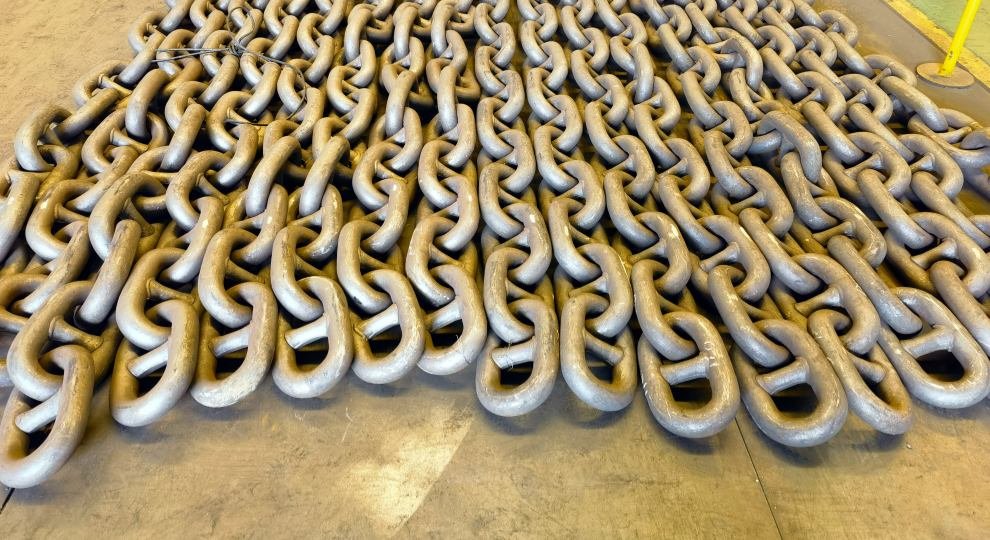
The weld zone is where stress fatigue commonly begins. Inspect for surface defects, incomplete penetration, or exposed metal. On stud link anchor chain, check the stud and its contact with the link. On studless anchor chain, check the link body and the heat-affected zone on both sides of the weld. Any coating damage on the hot-dip galvanized surface should also be noted.
3. Check Dimensions Against Tolerance
Verify bar diameter, inside length, inside width, and pitch. Confirm that anchor chain accessories such as Kenter shackles and end links fit properly, ensuring smooth assembly on-site without binding. Out-of-tolerance links should be segregated and never mixed into finished bundles.
4. Confirm Marking is Still Readable
Markings should include the manufacturer's mark, chain type and grade (e.g., AM2 / AM3 stud link, BM2 / BM3 studless), material grade (CM490 / CM690), batch number, and heat number. Unclear characters, inaccurate grade stamps, or markings placed on the load-bearing section are major issues.
5. Treat Breaking Load as a Limit, Not a Working Load
Mechanical samples are taken per lot. The minimum breaking load should be met. For AM3 / BM3 chain with CM690 material, low-temperature impact data should also be reviewed where required.
A key point for buyers: breaking load is not working load. The allowable Working Load Limit (WLL) is obtained by dividing the breaking load by a safety factor set by the project designer, not by the supplier.
6. Packing Protects the Coating and Traceability
Bundles of anchor chain should be bound firmly without crushing the links. Kenter shackles and other mooring fittings should be packed separately, with threads protected. Each bundle must carry a label indicating size, type, grade, material, heat number, and quantity.
When an Item Needs Attention
Heat numbers do not reconcile: Hold acceptance and require completion or a written explanation.
Surface weld defects: Hold the specific link and double the sample size.
Low impact energy: Segregate the lot and review the heat-treatment process.
Unclear marking: Re-inspect the lot and re-mark without obscuring the original stamp.
Coating damage: Re-galvanize the affected area, then re-inspect.
Out-of-tolerance dimensions: Segregate and do not mix into bundles.
Works Approval vs. Product Certification
A works approval is granted to a factory and confirms that its quality system, equipment, and process control can support repeated production. A product certification is issued for a specific batch and confirms that the order was witnessed, tested, and marked consistently.
The two are not interchangeable. For a first shipment from a new factory, process records and measured data matter most because there is no supply history to compare against.
Need Help Reviewing an Anchor Chain Shipment?
If an item in your inspection does not reconcile, send us the chain size, grade, material, and the records you have. Our engineering team can help identify where the issue sits in the production process.
SMEOCEAN supplies high-quality stud link anchor chain (AM2 / AM3) and studless anchor chain (BM2 / BM3) in CM490 / CM690 materials. We also provide hot-dip galvanized anchor chain and matching anchor chain accessories such as Kenter shackles and end links. Our factories are approved by major classification societies; batch-specific certifications are issued per order on request.
[Contact us] to discuss your anchor chain inspection protocols or to request a quotation.
Disclaimer: This article is general purchasing and factory self-inspection information. It is not a project suitability assessment, technical selection opinion or acceptance conclusion. Classification society names in this article refer only to facility approvals held by our factories. Contractual terms, delivery standards and acceptance methods are governed by the signed contract and its technical annex.
More Links:
How Anchor Chains are Manufactured?
Stud Link vs. Studless Anchor Chain: Which to Choose?