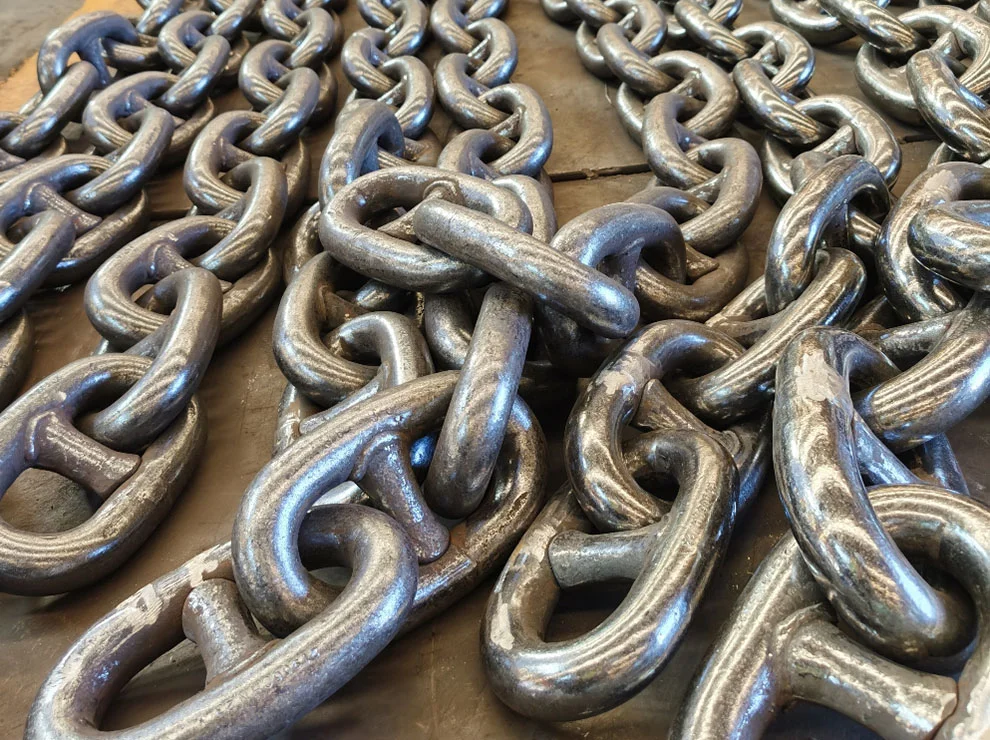
Fishing chains are corrosion-resistant chain systems designed specifically for aquaculture, fishing operations, and marine engineering. They are used to fix fishing nets, anchor aquaculture cages, connect fishing equipment, and bear loads in seawater and freshwater high-humidity environments. They must have three core properties: resistance to salt spray corrosion, high breaking load, and wear resistance.
Fishing chains have three specifications: short link chian, middle link chain and long link chain. Different types of fishing chains have different features.
Short Link Fishing Chain:
Short link fishing chain has a good yield performance that can meet a variety of applications. The short link chains are the heaviest among the fishing chain series. Its chain diameters range from 7mm, 10mm, 13mm, 16mm, 19mm to 20mm.
Mid Link Fishing Chain:
The strength of mid link chain is the same as short link chain, but due to its smaller number of links per meter, the wear of inner link is less. The mid link chains is lighter than short link chains and also cheaper. Mid link fishing chain diameter ranges from 10mm, 13mm, 14mm, 16mm, 19mm, 22mm to 26mm.
Long Link Fishing Chain:
Long link chains are much lighter than short link and mid link chains. The rotation space of its inner links is larger and convenient for the installation of accessories. Long link chain diameter ranges from 7mm, 9mm, 11mm, 13mm, 16mm, 19mm, 22mm to 28mm.
Fishing Chain Drawing:
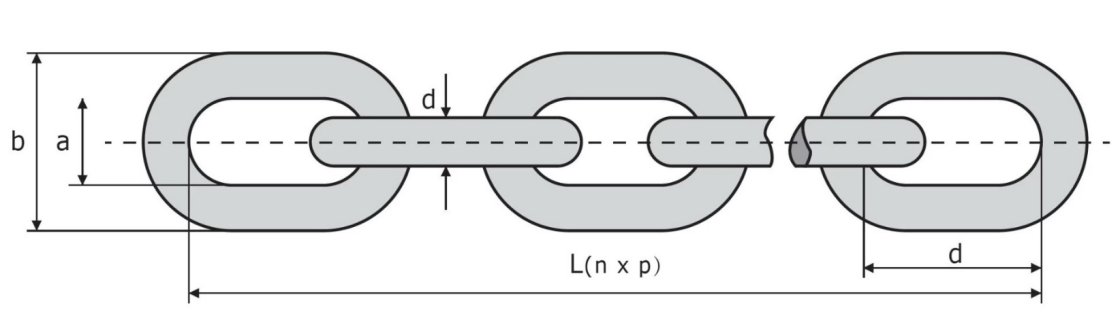
Specification of Fishing Chain (Studless) :
| Nominal | BM2(KN) | BM3(KN) | Weight (kg/m) |
| Dia(mm) | PL | BL | PL | BL | - |
| 12.5 | 41.2 | 56.4 | 82.6 | 112.8 | 85.41 |
| 14 | 51.0 | 70.8 | 101.9 | 141.5 | 106.6 |
| 16 | 66.2 | 92.4 | 132.3 | 184.8 | 139.4 |
| 17.5 | 78.9 | 110.6 | 157.8 | 221.1 | 178.4 |
| 19 | 93.6 | 130.3 | 187.2 | 260.6 | 217.7 |
| 20.5 | 108.6 | 151.7 | 217.3 | 303.4 | 229.1 |
| 22 | 125.4 | 174.4 | 250.9 | 349.4 | 264.5 |
| 24 | 149.9 | 207.9 | 298.9 | 415.8 | 341.8 |
| 26 | 175.4 | 244.0 | 350.8 | 488.0 | 369.9 |
| 28 | 203.8 | 283.0 | 406.7 | 566.0 | 427 |
| 30 | 234.2 | 324.9 | 467.5 | 649.8 | 491 |
| 32 | 265.6 | 369.6 | 531.2 | 739.3 | 559.7 |
| 34 | 299.9 | 417.3 | 599.8 | 834.6 | 671.5 |
| 36 | 336.1 | 467.8 | 672.3 | 935.7 | 707.9 |
| 38 | 374.4 | 521.3 | 748.7 | 1,042.5 | 789 |
| 40 | 414.5 | 577.6 | 829.1 | 1,155.2 | 869.4 |
| 42 | 457.7 | 636.8 | 915.3 | 1,273.2 | 959.3 |
| 44 | 502.7 | 698.9 | 999.6 | 1,398.0 | 1,111 |
| 46 | 548.8 | 763.9 | 1,097.6 | 1,527.8 | 1,152 |
| 48 | 597.8 | 831.7 | 1,195.6 | 1,663.5 | 1,256 |
| 50 | 648.8 | 902.5 | 1,239.6 | 1,805.0 | 1,360 |
| 52 | 697.6 | 976.1 | 1,395.3 | 1,952.3 | 1481 |
| 54 | 748.0 | 1,044.0 | 1,497.0 | 2,089.0 | 1712 |
| 56 | 802.0 | 1,119.0 | 1,603.0 | 2,237.0 | 1717 |
| 58 | 856.0 | 1,195.0 | 1,713.0 | 2,390.0 | 1842 |
| 60 | 913.0 | 1,274.0 | 1,826.0 | 2,547.0 | 2181 |
| 62 | 971.0 | 1,354.0 | 1,941.0 | 2,709.0 | 2104 |
Frequently Asked Questions (FAQ)
1. Stud link or studless fish chain – which to choose for aquaculture mooring?
For fish farm mooring systems, stud link fish chain is stronger, less prone to tangling, and recommended for deep-sea aquaculture (water depth over 50 meters) and strong current areas. Salmon farms in Norway and Chile commonly use 26-36mm stud link anchor chain for their aquaculture mooring.
Studless fishing chain is lighter and cheaper, suitable for shallow water fish farming (depth under 30 meters) or calm conditions.
Unsure about your aquaculture mooring setup? Tell us your water depth and sea conditions – we will recommend the right fish chain for your farm.
2. What anchor for deep-sea aquaculture cages?
Deep-sea fish farming cages use high-holding-power drag embedment anchors, not concrete sinkers which lack holding power at depth. We recommend three types for aquaculture mooring: Stingray Anchor (holding power over 40 times its own weight), Drag Anchor (for sand and mud bottoms), and Sand Plough Anchor (plough-shaped, sets quickly).
We also offer matching fish chain and anchor packages for complete aquaculture mooring systems. See our anchor pages for details.
3. Short link, mid link, or long link fishing chain – what's the difference?
Short link fishing chain is the heaviest with the highest strength, best for deep-sea mooring and heavy aquaculture loads. Mid link aquaculture chain is moderate in weight and cost, ideal for general fish farm mooring. Long link fishing chain is the lightest with more rotation space, suitable for accessory connections and flexible joints in aquaculture systems.
Rule of thumb: Deep water and heavy loads – choose short link fish chain. Shallow water – choose mid link aquaculture chain. Accessories – choose long link fishing chain.
4. How to maintain aquaculture fishing chains?
Rinse your fishing chain with fresh water after each use. Inspect regularly for deformation, cracks, and wear – replace when fish chain diameter wear exceeds 8-10%. Apply anti-rust grease or marine lubricant, especially on pin joints and contact surfaces. Keep maintenance logs with inspection dates and replacement records for your aquaculture mooring system.
5. Why do Norwegian fish farms need certified anchor chains?
Three reasons for choosing certified fish chain.
First, insurance requirement – insurers require valid product certificates for aquaculture mooring components.
Second, fish escape prevention – Norwegian regulations require certified mooring to ensure fish farm pen integrity.
Third, compliance – fish farms need site and installation certificates; some financing agreements also require certified aquaculture mooring documentation.
Bottom line: The cost of certified fishing chain is far less than a single fish escape incident.