The Stingray Anchor is a high-efficiency drag embedment anchor designed for aquaculture and marine mooring. With holding power exceeding 40 times its own weight, it significantly outperforms conventional anchors of similar size.
Weighing only 75% of a traditional anchor while delivering 1.3 times the holding power, the Stingray anchor reduces shipping costs and simplifies handling. Its foldable design allows for easy assembly without special tools.
Ideal for fish farm mooring, cyclone mooring systems, and sensitive marine environments. The Stingray anchor embeds rapidly with minimal seabed disturbance – a critical advantage for environmentally regulated areas.
Stingray Anchor Drawing:
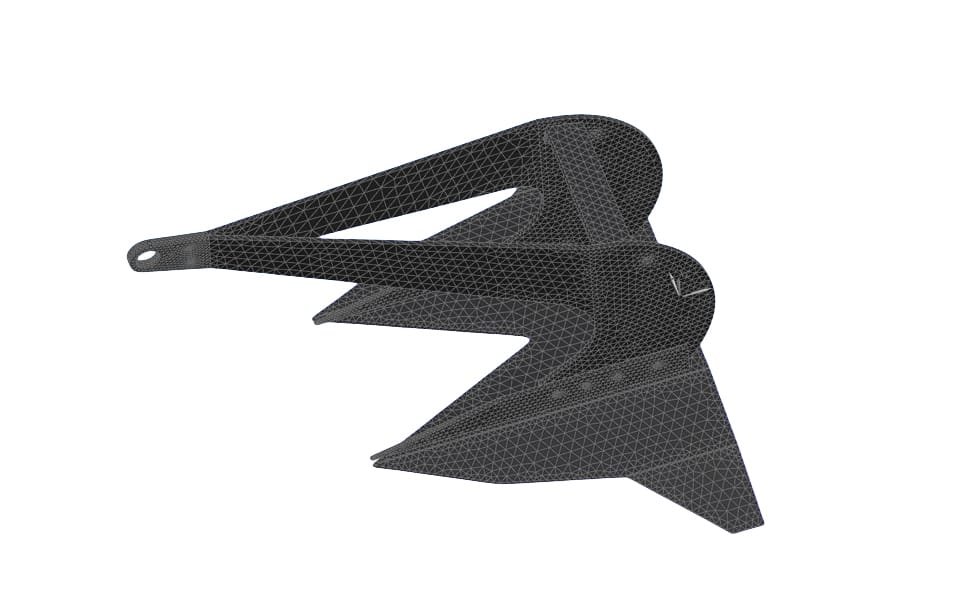
Specification of Stingray Anchor:
| Weight (Kg) | Holding Power (Tons) | Break Load (Tons) | Proof Load (Tons) |
| 500 | 21 | 63 | 18.9 |
| 750 | 32 | 96 | 28.8 |
| 1000 | 40 | 120 | 36 |
| 1200 | 48 | 150 | 44 |
| 1500 | 56 | 168 | 50.4 |
| 2000 | 69 | 207 | 62.1 |
| 2500 | 87.5 | 262.5 | 78.75 |
Frequently Asked Questions (FAQ)
1. How does the Stingray anchor achieve such high holding power?
The Stingray anchor is a drag embedment anchor with a dual fluke design that penetrates the seabed rapidly upon contact. Once buried, its wide surface area creates holding power exceeding 40 times its own weight in sand and stiff clay. Unlike deadweight anchors, it digs deeper under tension rather than being pulled out.
2. What seabed conditions are suitable for the Stingray anchor?
The Stingray anchor performs best in sand, medium clay, silt, and soft sediments – common in aquaculture areas. It is well-suited for muddy or sandy bottoms where other anchors may struggle. For rocky seabeds or very thin sediment layers, other anchor types may be more appropriate.
SMEOCEAN manufacture Stingray anchors from 10kg to 5,000kg, with 1,000kg, 1,200kg, and 1,500kg being the most commonly used sizes for fish farm projects.
3. Why is the Stingray anchor shipped disassembled?
Traditional welded anchors take up significant container space, with only a few units fitting per 40ft container. Our Stingray anchor features a bolt-together design – it ships flat in pieces and reassembles quickly on-site without special tools. This saves shipping costs and simplifies handling, especially at remote locations without heavy lifting equipment.
4. How do I maintain a Stingray anchor in saltwater?
Inspect regularly for corrosion, deformation, or cracks before each use. After saltwater exposure, rinse with fresh water and apply anti-rust treatment, especially to bolted joints. Replace or remove from service if any damage is found.
5. How does the Stingray anchor compare to other drag anchors?
All drag anchors work on the same principle, but the Stingray anchor offers clear advantages: 40x holding power-to-weight ratio vs 10-15x for conventional anchors, 75% of the weight with 1.3x the holding power, minimal seabed disturbance, and bolt-together shipping. For deep-sea fish farms and cyclone mooring systems, it is a proven choice.