The HHP Plough Anchor is a next-generation plough anchor upgraded from the classic design with reinforcement ribs and fully welded construction. It features a streamlined profile with enhanced structural strength, suitable for marine, offshore, and aquaculture mooring applications.
Its key advantage lies in the single plough-shaped fluke design: it penetrates the seabed quickly and deeply upon deployment, providing reliable holding power in sand, mud, gravel, clay, and even grassy bottoms. Whether for yachts, workboats, offshore platforms, or fish farms, the HHP Plough Anchor offers dependable mooring support.
HHP Plough Anchor Diagram:
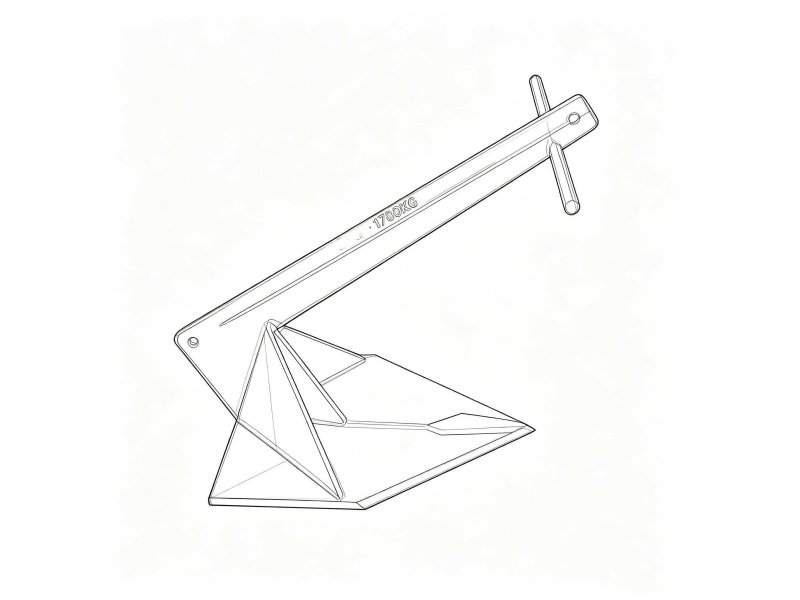
Specification of HHP Plough Anchor:
| Weight(kg) | Holding Power (Tons) | Break Load (Tons) | Proof Load ( N ) |
| 500 | 10 | 30 | 15 |
| 750 | 15 | 45 | 22.5 |
| 1000 | 20 | 60 | 30 |
| 1500 | 30 | 90 | 45 |
| 2000 | 40 | 120 | 60 |
| 2500 | 50 | 150 | 75 |
Frequently Asked Questions (FAQ)
1. What are the key features of the HHP Plough Anchor?
High-strength welded construction: Fully welded design delivers superior overall strength compared to traditional cast plough anchors, ensuring structural reliability.
Reinforcement ribs: Added at critical load-bearing points to improve bending resistance and maintain stability in hard seabeds and other challenging conditions.
Single plough-shaped fluke design: Penetrates the seabed quickly upon deployment, adapting to various bottom types.
Streamlined appearance: Clean lines and balanced structure – combining industrial strength with visual appeal.
2. Are there any limitations to the HHP Plough Anchor?
The fully welded reinforced design results in a larger overall structure that cannot be easily disassembled. This means container utilization is lower compared to modular anchor types, leading to higher shipping costs. For long-distance export orders, we recommend considering the modular/detachable version to optimize freight costs.
3. What are the typical applications of the HHP Plough Anchor?